Search the site...

SOL DE MEDIANOCHE
  • ENERO 2026
  • DICIEMBRE 2025
  • NOVIEMBRE 2025
  • OCTUBRE 2025
  • SEPTIEMBRE 2025
  • Advertise with us!
  • Contact
  • DONATE
  • ENERO 2026
  • DICIEMBRE 2025
  • NOVIEMBRE 2025
  • OCTUBRE 2025
  • SEPTIEMBRE 2025
  • Advertise with us!
  • Contact
  • DONATE

Governor Dunleavy “Flunks” on Education
by carlos matías

Picture

Alaska’s Republican governor, Mike Dunleavy, has an “issue pending” in his education policy that will “impoverish society,” according to experts, educators, and families of students. “Increase the BSA” is the cry of educators and public-school advocates in demonstrations that have been taking place for months.

Last May, the legislature approved a $175 million increase in funding for public education in Alaska. In June, Governor Dunleavy vetoed half of that increase without explanation. That is, he vetoed $87 million of the approved $175 million.
In December, Mike Dunleavy declared education one of his “top priorities” and announced a budget of more than $1.2 billion ($1,267,522,300) for the department. However, this amount represents a 9% decrease in the Base Student Allocation  (BSA) from the previous year’s budget.

In January, the legislature meeting in Juneau could have overridden the governor’s veto of the 50% funding increase, but the lawmakers didn’t do it. This has created what many education experts and pundits are calling a “public school funding crisis.”

At best, this fiscal year’s Basic Student Allocation (BSA) could be quantified at $5,960 per student in each of the 54 districts into which education is divided in Alaska. This figure is only $30 higher than the $5,930 BSA that was unchanged from 2017 to 2023. A “ridiculous” increase, according to sources consulted by Sol de Medianoche, especially because of the steady rise in the cost of living over the past seven years and the loss of purchasing power of citizens. “We have very high inflation,” notes Beysi Collante, a Venezuelan mother of a seven-year-old girl in second grade.

“Funding for classrooms and teachers is one of the main needs of the state’s public schools,” says Joelle Hall. Joelle has no school-age children (her son is in college), but she is the president of the AFL-CIO, the largest union federation in the U.S.
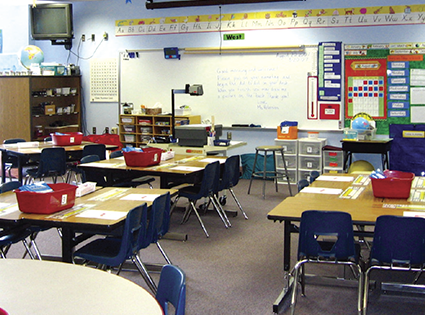
Lara Nations, an immigration attorney, on the other hand, has two children in elementary school in Anchorage and believes that “public schools are woefully underfunded. Class sizes have skyrocketed. Kids are crammed into classrooms, and teachers have to teach too many kids at the same time.”
“Schools don’t have adequate supplies, which means that teachers often have to spend their own money to get what they need for their classrooms,” says Lara Nations.

Paola Kennah is a Peruvian mother of a school-age girl. She says that “they are also considering cutting programs like language immersion,” something Lara Nations considers “very important,” especially the Spanish immersion program for Hispanic students and families. Lara is married to a lawyer of Hispanic descent.

Itzel Zagal, a Mexican mother of an eleven-year-old boy in fifth grade in the Anchorage School District, says that teachers “have a heavy workload” and lack the resources, “the lack of support for language immersion is very serious in a state like Alaska, which is the most multicultural state in the country.”

In addition, Paola Kennah denounces that it is increasingly difficult to have access to education, “especially if there is no transportation” and “specifically in rural areas” besides “schools around the city have been closed, which means that [children] have to be redirected to other schools and if there is no transportation, it will be difficult for them to attend.”
“Governor Dunleavy’s education budget cut is very troubling,” comments Itzel Zagal, “and it affects the working class and their children. The cut also affects teachers and professors. If they must work in poor conditions, the best educators will tend to leave the school district. This cut will impoverish the whole of Alaskan society.”

“I have no idea what the governor’s goal is with education. But he should focus his efforts on the welfare of the schools. Children are the future of this state,” says Beysi Collante.
“We need full funding for students (BSA) and a living wage for teachers and support staff,” adds Cynthia Gachupin, a Mexican American and mother of three children in eleventh, ninth and first grades. “Only then will we be able to retain these professionals who are the backbone of a healthy school system.”
​
Sol de Medianoche asked for opinions from other parents of different nationalities and backgrounds with school-age children who will be affected by these cuts. But their responses did not arrive in time to be included in this month’s edition. 

PROUDLY POWERED BY SOL DE MEDIANOCHE NEWS, LLC.
Sol de Medianoche is a monthly publication of the Latino community in Anchorage, Alaska